Ads-Banner Header

Showing posts with label Struktur. Show all posts

Friday, June 7, 2013

ebook - Perencanaan Struktur Baja Dengan Metode LRFD (Berdasarkan SNI 03-1729-2002)

Perencanaan Struktur Baja Dengan Metode LRFD (Berdasarkan SNI 03-1729-2002) | Agus Setiawan | Penerbit Erlangga | 2008 | Bahasa Indonesia | 340 p | pdf | 19.7 MB | ISBN: 978-979-033-478-6 | Dalam buku ini, dibahasa mengenai konsep dasar LRFD, pengenalan material baja, batang tarik dan tekan, sambungan (baut dan las), komponen struktur balok-kolom, komponen struktur komposit serta jenis-jenis sambungan pada konstruksi bangunan baja.
ebook - Perencanaan Struktur Baja Dengan Metode LRFD (Berdasarkan SNI 03-1729-2002)
Judul Buku
:
Perencanaan Struktur Baja Dengan Metode LRFD (Berdasarkan SNI 03-1729-2002)
Penulis
:
Agus Setiawan
Penerbit
:
Penerbit Erlangga
Tahun
:
2008
Bahasa
:
Bahasa Indonesia
Bahasa
:
340 hal
Format File
:
pdf
Ukuran File
:
19.7 MB
PRAKATA
Metode ASD (Allowable Stress Design) dalam struktur baja telah cukup lama digunakan, namun beberapa tahun terakhir metode desain dalam struktur baja mulai beralih ke metode lain yang lebih rasional, yakni metode LRFD (Load Resistance and Factor Design). Metode ini didasarkan pada ilmu probabilitas, sehingga dapat mengantisipasi segala ketidakpastian dari material maupun beban. Oleh karena itu, metode LRFD ini dianggap cukup andal. Peraturan Perencanaan Bangunan Baja Indonesia (PPBBI 1987) telah diganti dengan Tata Cara Perencanaan Struktur Baja untuk Bangunan Gedung, SNI 03-1729-2002 yang berbasis pada metode LRFD.
Buku ini mencoba memberikan penjelasan mengenai perencanaan struktur baja dengan menggunakan konsep LRFD tersebut. Dalam perencanaan struktur baja metode LRFD yang digunakan dalam buku ini, semuanya berpedoman pada SNI 03-1729-2002 yang telah disebutkan sebelumnya.
Dalam buku ini, dibahasa mengenai konsep dasar LRFD, pengenalan material baja, batang tarik dan tekan, sambungan (baut dan las), komponen struktur balok-kolom, komponen struktur komposit serta jenis-jenis sambungan pada konstruksi bangunan baja.
Selain dapat digunakan oleh mahasiswa Teknik Sipil, buku ini juga dapat dijadikan pedoman perencanaan bagi konsultan maupun praktisi yng berkecimpung di dunia struktur baja.
DAFTAR ISI

Prakata

Daftar Isi

Bab 1 PENDAHULUAN

1.1.   Perencanaan Struktur

1.2.   Beban

1.3.   Konsep Dasar LRFD

1.4.   Peluang Kegagalan

1.5.   Indeks Keandalan

1.6.   Desain LRFD Struktur Baja

Bab 2 MATERIAL BAJA DAN SIFAT-SIFATNYA

2.1    Sejarah Penggunaan Material Baja

2.2    Material Baja

2.3    Sifat-sifat Mekanik Baja

2.4    Keuletan Baja

2.5    Tegangan Multiaksial

2.6    Perilaku Baja pada Temperatur Tinggi

2.7    Pengerjaan Dingin dan Penguatan Regangan

2.8    Keruntuhan Getas

2.9    Sobekan Lamelar

2.10  Keruntuhan Leleh

Bab 3 BATANG TARIK

3.1    Pendahuluan

3.2    Tahanan Nominal

3.3    Luas Netto

3.4    Efek Lubang Berselang-Seling pada Luas Netto

3.5    Luas Netto Efektif

3.6    Geser Blok (Block Shear)

3.7    Kelangsingan Struktur Tarik

3.8    Transfer Gaya Pada Sambungan

Bab 4 BATANG TEKAN

4.1   Pendahuluan

4.2   Teknik Elastik Euler

4.3   Kekuatan Kolom

4.4   Pengaruh Tegangan Sisa

4.5   Kurva Kekuatan Kolom Akibat Tegangan Sisa

4.6   Tahanan Tekan Nominal

4.7   Panjang Tekuk

4.8   Masalah Tekuk Lokal

4.9   Komponen Struktur Tekan Tersusun

4.10 Tekuk Torsi dan Tekuk Lentur Torsi

Bab 5 KOMPONEN STRUKTUR LENTUR

5.1   Pendahuluan

5.2   Lentur Sederhana Profil Simetris

5.3   Perilaku Balok Terkekang Lateral

5.4   Desain Balok Terkekang Lateral

5.5   Lendutan Balok

5.6   Geser pada Penampang Gilas

5.7   Beban Terpusat Pada Balok

5.8   Teori Umum Lentur

Bab 6 SAMBUNGAN BAUT

6.1   Pendahuluan

6.2   Tahanan Nominal Baut

6.3   Geser Eksentris

6.4   Kombinasi Geser dan Tarik

6.5   Sambungan yang Mengalami Beban Tarik Aksial

6.6   Geser dan Tarik Akibat Beban Eksentris

Bab 7 SAMBUNGAN LAS

7.1   Pendahuluan

7.2   Jenis-jenis Sambungan

7.3   Jenis-jenis Las

7.4   Pembatasan Ukuran Sudut Las

7.5   Luas Efektif Las

7.6   Tahanan Nominal Sambungan Las

7.7   Geser Eksentris-Metode Elastik

7.8   Geser Eksentris-Metode Plastis

7.9   Beban Eksentris Normal pada Bidang Las

Bab 8 TORSI

8.1   Pendahuluan

8.2   Torsi Murni pada Penampang Homogen

8.3   Pusat Geser (Shear Center )

8.4   Tegangan Puntir Pada Profil I

8.5   Analogi Torsi dengan Lentur

Bab 9 TEKUK TORSI LATERAL

9.1   Pendahuluan

9.2   Perilaku Balok I Akibat Beban Momen Seragam

9.3   Tekuk Torsi Lateral Elastis

9.4   Tekuk Torsi Inelastis

9.5   Desain LRFD Balok I

9.6   Lentur Dua Arah

Bab 10 BALOK PELAT BERDINDING PENUH (PELAT GIRDER )

10.1   Pendahuluan

10.2   Persyaratan Balok Pelat Berdinding Penuh

10.3   Kuat Momen Nominal Balok Pelat Berdinding Penuh

10.4   Kuat Geser Nominal

10.5   Kuat Geser Nominal dengan Pengaruh Aksi Medan Tarik

10.6   Interaksi Geser dan Lentur

10.7   Pengaku Vertikal

10.8   Pengaku Penahan Gaya Tumpu

10.9   Desain Balok Pelat Berdinding Penuh

Bab 11 BALOK KOLOM

11.1   Pendahuluan

11.2   Persamaan Differensial untuk Kombinasi Gaya Aksial dan Lentur

11.3   Faktor Perbesaran Momen

11.4   Desain LRFD Komponen Struktur Balok-Kolom

11.5   Perbesaran Momen untuk Struktur Tak Bergoyang

11.6   Perbesaran Momen untuk Struktur Bergoyang

11.7   Tekuk Lokal Web pada Komponen Struktur Balok-Kolom

Bab 12 KOMPONEN STRUKTUR KOMPOSIT

12.1   Struktur Komposit

12.2   Tegangan Elastis dalam Balok Komposit

12.3   Lebar Efektif Balok Komposit

12.4   Sistem Pelaksanaan Komponen Struktur Komposit

12.5   Kuat Lentur Nominal

12.6   Penghubung Geser

12.7   Balok Komposit pada Daerah Momen Negatif

12.8   Lendutan

12.9   Dek Baja Gelombang

12.10 Kolom Komposit

Bab 13 SAMBUNGAN PADA KONSTRUKSI BANGUNAN GEDUNG

13.1   Sambungan Balok Induk dengan Balok Anak

13.2   Sambungan Balok-Kolom

13.3   Sambungan Balok-Kolom Diperkaku

13.4   Sambungan Penahan Momen

13.5   Sambungan Balok-Kolom dengan Pengaku

LAMPIRAN

JAWABAN SOAL LATIHAN

DAFTAR PUSTAKA

INDEKS

Tuesday, February 5, 2013

ebook - Seismic Design of Reinforced and Precast Concrete Buildings

Seismic Design of Reinforced and Precast Concrete Buildings | ROBERT E. ENGLEKIRK | JOHN WILEY & SONS, INC. | 2003 | English | 853 p | pdf | 16.57 MB | ISBN : 0-471-08122-1 | Knowledge and imagination are essential components of the design process. Imagination without knowledge will quite often produce designs that are dangerous. Knowledge absent imagination can only produce designs of limited scope. The development and integration of these themes is the objective of this book.
ebook - Seismic Design of Reinforced and Precast Concrete Buildings
Book Title
:
Seismic Design of Reinforced and Precast
Concrete Buildings
Authors
:
ROBERT E. ENGLEKIRK
Publisher
:
JOHN WILEY & SONS, INC.
Year
:
2003
Language
:
English
Pages
:
853 p
File Format
:
pdf
File Size
:
16.57 MB
PREFACE
Knowledge and imagination are essential components of the design process. Imagination without knowledge will quite often produce designs that are dangerous. Knowledge absent imagination can only produce designs of limited scope. The development and integration of these themes is the objective of this book.
My hope is to advance the reader’s ability to design by reducing existing experimentally developed conclusions to design-relevant relationships and limit states. The reduction of experimental data to a usable form is essential to the design process because an engineer, faced with a design decision, cannot confidently develop a design approach from experiment data or basic principles as a part of each design, especially if the basic principle is not a part of his or her working vocabulary. Behavior models must also be available to and accepted by the designer.
INTRODUCTION
This book is primarily about design, which, as I use the term, is the creative process that seeks the proper blend of essential ingredients—specifically function, aesthetics, economy, and, in the context of this book, seismic behavior. There exists no single formula for creating a good design, for the design process involves making a set of decisions on issues for which no absolutely right answer exists. Thus the designer is continually seeking a comfortable rationally based design solution, and two identical solutions are not likely to be produced even successively by the same constructive designer.
Tools are essential to the completion of almost every task. I have tried to assemble, in as concise a form as possible, the tools necessary to the pursuit of a good design. From the extensive library of experimental efforts, I have selected representative works and demonstrated how both strength and deformation limit states might be predicted. Next, I review alternative design approaches and, in the process, simplify and adapt them to specific types of bracing systems. Finally I describe how designs might be comprehensively reviewed.
The focus of the book is concrete and the emphasis is on precast concrete. I have limited the scope to the satisfaction of seismic behavior objectives because the topic is complex and, though extensively studied and codified, not necessarily well understood by the structural design profession. The fact that seismic design can be reduced to an understandable level that can be creatively introduced into a building program makes it an ideal vehicle to study the design process.
Table of Contents

PREFACE

NOMENCLATURE

INTRODUCTION

1. BASIC CONCEPTS

1.1
Ductility—A System Behavior Enhancer
1.2
Confinement—A Component Behavior Enhancement
1.3
Shear
Selected References

2. COMPONENT BEHAVIOR AND DESIGN

2.1
Beams
2.2
The Beam Column
2.3
Beam-Column Joints
2.4
Shear Dominated Systems
Selected References

3. SYSTEM DESI

3.1
Shear Wall Braced Buildings
3.2
Frame Braced Buildings
3.3
Diaphragms
3.4
Design Process Overview
Selected References

4. DESIGN CONFIRMATION

4.1
Response of Shear Wall Braced Buildings to Ground Motion
4.2
Frame Braced Buildings
4.3
Behavior Imponderables
Selected References

INDEX

Wednesday, January 9, 2013

Manual For Analysis & Design Using ETABS

Manual For Analysis & Design Using ETABS by Atkins | - | Structural Department, Atkins Dubai | 2007 | English | 46 p | pdf | 20.41 MB | The primary objective of this document is to make sure that ETABS is used consistently by the structural engineers in Atkins office in Dubai in terms of : modelling and analysis procedures; use of applicable built-in international codes; And complying with local authorities specific requirements;. This document is intended to complement the ETABS manuals and other relevant technical papers published by CSI. It is assumed that the user of this manual has a good command of ETABS and is familiar with the following codes : UBC 97 seismic provisions; ASCE 7 provisions for wind loading; BS codes of practice;.
Manual For Analysis & Design Using ETABS by Atkins
Book Title
:
Manual For Analysis & Design
Using ETABS
Authors
:
-
Publisher
:
Structural Department, Atkins Dubai
Year
:
2007
Language
:
English
Pages
:
46 p
File Format
:
pdf
File Size
:
20.41 MB
Objective
The primary objective of this document is to make sure that ETABS is used consistently by the structural engineers in Atkins office in Dubai in terms of :
  • modelling and analysis procedures
  • use of applicable built-in international codes
  • And complying with local authorities specific requirements.
This document is intended to complement the ETABS manuals and other relevant technical papers published by CSI. It is assumed that the user of this manual has a good command of ETABS and is familiar with the following codes :
  • UBC 97 seismic provisions
  • ASCE 7 provisions for wind loading
  • BS codes of practice.
Local Authority specific requirements are covered in Appendices at the end of this document.
The procedures in this document are based on standard practice in Dubai. However, for specific projects, some parameters or procedures need to be revised. This shall be done in accordance with the design statement and in conjunction with the project lead engineer.
Table of Contents

1. File Menu

1.1
Open a Pre-defined Template
1.2
Import Geometry
 
Import DXF file of architectural grid
 
Import DXF floor plan
 
Import DXF file of 3D model

2. Material properties

2.1
Concrete
 
Define Concrete grade
 
Define Concrete mass and weight per unit volume
 
Define Concrete modulus of Elasticity
2.2
Reinforcement

3. Definition & Sizing of Elements

3.1
Define Frame Elements
3.2
Define Shell Elements
3.3
Assign Frame or Shell section properties
3.4
Assign Frame section modifiers
3.5
Assign Shell section modifiers
3.6
Assign Pier / Spandrel Labels
3.7
Assign area object mesh options
3.8
Assign auto-line constraint

4. Supports

4.1
General Support Conditions
4.2
Modelling Piles as Supports (define spring stiffness values)

5. Loading

5.1
Dead Loads
 
Assign Self weight
 
Define Imposed dead load
5.2
Live Loads
5.3
Mechanical Loads
5.4
Wind Loads
 
Codified Method
 
ASCE 7 Method
 
BS 6399 Method
 
Extracting Wind Loads from Wind Tunnel Test Results
5.5
Earthquake Loads
 
Define Equivalent Static Force Method
 
Response Spectrum Analysis
 
Define Response Spectrum functions as per UBC 97 requirements
 
Define Response Spectrum cases and parameters

6. Load Combinations

6.1
Define Load combinations for Serviceability State
6.2
Define Load combinations for Ultimate State
6.3
Define Load combinations for Pile Design

7. Analysis Options

7.1
Dynamic analysis options (Ritz vs. Eigenvector)
7.2
P-Delta analysis options
 
For Local Authorities other than JAFZA
 
For JAFZA

8. Post-Analysis Checks

8.1
Analysis log & results
 
Warnings/div>
 
Global force balance
8.2
Deformed shape and modal animations
8.3
Modal characteristics (modal amplitude, mass participation ratio)

9. Reinforced Concrete Design Module

9.1
Shear Walls Design Module (BS 8110-97)
9.2
Reinforced Concrete Frame Design (BS 8110-97) Beams

Thursday, October 11, 2012

ETABS USER’S MANUAL : Three Dimensional Analysis and Design of Building Systems

| ETABS USER’S MANUAL ; Three Dimensional Analysis and Design of Building Systems | - | Computers and Structures, Inc. | First Edition, December 1999 | English | 895 p | pdf | 4.25 MB | Organization of This Manual : Volume 1 (Chapters 1 through 3: General introduction and information on installation and getting help. This is the "Getting Started" portion of the manual.Chapters 4 through 6: A general overview of ETABS. Chapter 6 provides useful information about how to create models in ETABS. Chapters 7 through 19: Detailed discussion of each of the ETABS menus). Volume 2 (Chapters 20 through 33: Additional detailed information on selected ETABS topics. Chapters 34 through 44: Documentation of the analysis output for ETABS). |
ETABS USER’S MANUAL : Three Dimensional Analysis and Design of Building Systems
Book Title
:
ETABS USER’S MANUAL
Three Dimensional Analysis and Design of Building Systems
Authors
:
-
Publisher
:
Computers and Structures, Inc.
Year
:
First Edition, December 1999
Language
:
English
Pages
:
895 p
File Format
:
pdf
File Size
:
4.25 MB
Organization of This Manual
We have tailored the content of all of the ETABS manuals more toward a design engineer than a computer analyst. This manual is divided into six parts in two separate volumes that are described below :
Volume 1
  • Chapters 1 through 3: General introduction and information on installation and getting help. This is the "Getting Started" portion of the manual.
  • Chapters 4 through 6: A general overview of ETABS. Chapter 6 provides useful information about how to create models in ETABS.
  • Chapters 7 through 19: Detailed discussion of each of the ETABS menus.
Volume 2
  • Chapters 20 through 33: Additional detailed information on selected ETABS topics.
  • Chapters 34 through 44: Documentation of the analysis output for ETABS.
ETABS User’s Manual Chapter List
Volume 1 Contents
Chapter List
Expanded Table of Contents
Introduction and Getting Started Information
Chapter 1
Introduction
Chapter 2
Installation
Chapter 3
Getting Help
General Overview of ETABS
Chapter 4
The ETABS Graphical User Interface
Chapter 5
Overview of an ETABS Model
Chapter 6
ETABS Modeling Tips
The ETABS Menus
Chapter 7
Overview of the ETABS Menus
Chapter 8
The ETABS File Menu
Chapter 9
The ETABS Edit Menu
Chapter 10
The ETABS View Menu
Chapter 11
The ETABS Define Menu
Chapter 12
The ETABS Draw Menu
Chapter 13
The ETABS Select Menu
Chapter 14
The ETABS Assign Menu
Chapter 15
The ETABS Analyze Menu
Chapter 16
The ETABS Display Menu
Chapter 17
The ETABS Design Menu
Chapter 18
The ETABS Options Menu
Chapter 19
The ETABS Help Menu
References
Index
Volume 2 Contents
Chapter List
Expanded Table of Contents
The ETABS Menus
Chapter 20
Units
Chapter 21
Coordinate Systems
Chapter 22
Story Level Data
Chapter 23
Area Objects
Chapter 24
Line Objects
Chapter 25
Point Objects
Chapter 26
Groups and Section Cuts
Chapter 27
Load Cases, Load Combinations and Mass
Chapter 28
Automatic Seismic Loads
Chapter 29
Automatic Wind Loads
Chapter 30
Automatic Meshing of Area and Line Objects
Chapter 31
Manual Meshing of Area Objects
Chapter 32
Transformation of Loads into the ETABS Analysis Model
Chapter 33
Overview of ETABS Analysis Techniques
Chapter 34
Point Object Output Conventions
Chapter 35
Frame Element Output Conventions
Chapter 36
Shell Element Output Conventions
Chapter 37
Link Element Output Conventions
Chapter 38
Wall Pier and Spandrel Output Conventions
Chapter 39
Section Cut Output Conventions
Chapter 40
Printed Input Tables
Chapter 41
Printed Output Tables
Chapter 42
Database Input/Output Tables
Chapter 43
The ETABS Log and Out Files
Chapter 44
Inserting ETABS Output into Written Reports
Introduction to the ETABS Design Postprocessors
Chapter 45
Steel Frame Design
Chapter 46
Concrete Frame Design
Chapter 47
Composite Beam Design
Chapter 48
Shear Wall Design
References
Appendix 1 - The ETABS Menu Structure
Index

Saturday, September 1, 2012

ebook - Reinforce Concrete, Analysis and Design

Reinforce Concrete, Analysis and Design | SS Ray | Blackwell Science, Ltd. | 1995 | English | 556 p | pdf | 11.48 MB | ISBN : 0-632-03724-5 | The highly structured step-by-step methodology I have used makes the book fully comprehensive and user-friendly. Accordingly, the task of quality assurance becomes less arduous and the product or output of a design office becomes fully standardised if this approach is strictly followed. For students, the book should prove to be invaluable because the essential elements of the theory of reinforced concrete are discussed, followed by a structured approach to the design of all elements in a building, including foundations and the connections of the reinforced concrete members to each other to create a complete building. The numerous worked examples should be very useful to students and practitioners alike. The book also presents practical advice on designing reinforced concrete elements and the student should benefit from learning the methods adopted in a design consultancy.
ebook - Reinforce Concrete, Analysis and Design
Book Title
:
Reinforce Concrete, Analysis and Design
Authors
:
SS Ray
Publisher
:
Blackwell Science, Ltd.
Year
:
1995
Language
:
English
Pages
:
556 p
File Format
:
pdf
File Size
:
11.48 MB
Preface
I believe that the contents of this book will prove to be extremely valuable to practising engineers, students and teachers in the field of reinforced concrete design. There are many excellent books available dealing with the design of reinforced concrete elements but, in my opinion, they lack completeness in certain ways. The design of a reinforced concrete member requires many checks in a systematic structured manner and the step-by-step approach adopted in this book is intended to ensure that the design process is complete in all respects. It is my view that the member itself, when fully designed, does not constitute a complete design because it ignores the connections to other members and to the foundation that are needed to provide true completeness of design for the structure. I have attempted here to elucidate the necessary global analysis. Also, most books on reinforced concrete design do not deal with the aspects of soil structure interaction problems and are hence incomplete.
The highly structured step-by-step methodology I have used makes the book fully comprehensive and user-friendly. Accordingly, the task of quality assurance becomes less arduous and the product or output of a design office becomes fully standardised if this approach is strictly followed. For students, the book should prove to be invaluable because the essential elements of the theory of reinforced concrete are discussed, followed by a structured approach to the design of all elements in a building, including foundations and the connections of the reinforced concrete members to each other to create a complete building. The numerous worked examples should be very useful to students and practitioners alike. The book also presents practical advice on designing reinforced concrete elements and the student should benefit from learning the methods adopted in a design consultancy.
My intention has been to illustrate the design principles at each stage by using a profusion of sketches. The book includes many more illustrations than a standard textbook on reinforced concrete because it was felt necessary to clear all ambiguities in the codes of practice by the use of diagrams, an approach which should appeal to both practising engineers and students.
The book includes a lot more new design aids than are usually found in the available books. For instance, the tables and charts included in this book for the design of solid slabs and flat slabs cannot be found in other published textbooks on the subject. References to many published books on the subject of reinforced concrete are also given.
I would like to thank the British Standards Institution for their kind permission to reproduce some of the essential tables from the codes of practice. I also wish to thank the US Army Armament Research and Development Centre, Picatinny Arsenal, NJ and Amman and Whitney, Consulting Engineers, New York for granting permission to reproduce the extremely useful charts on the yield-line design of slabs in Chapter 3.
Contents at a Glance

Preface

References

Chapter 1 Theory of Reinforced Concrete

Chapter 2 Design of Reinforced Concrete Beams

Chapter 3 Design of Reinforced Concrete Slabs

Chapter 4 Design of Reinforced Concrete Columns

Chapter 5 Design of Corbels and Nibs

Chapter 6 Design of Pad Foundations

Chapter 7 Design of Piled Foundations

Chapter 8 Design of Walls

Chapter 9 Design of Flat Slabs

Chapter 10 Design of Connections

Chapter 11 General Figures, Tables and Charts

Index

Tuesday, August 21, 2012

CSi SAP2000 v 15 Ultimate

civiliana-CSI SAP2000 v 15 UltimateFree Download CSi SAP2000 v 15 Ultimate - full free.
Di dunia teknik sipil, SAP2000 sudah sangat populer dan lazim digunakan, terutama dalam desain dan analisis struktur.
Pada postingan terdahulu, [civiliana] telah memberikan link download untuk software CSi SAP2000 v 14. Kali ini, [civiliana] sajikan CSi SAP2000 Ultimate v 15.0.0.

Software ini dapat anda download secara gratis, melalui link download yang [civiliana] cantumkan pada bagian akhir postingan ini.
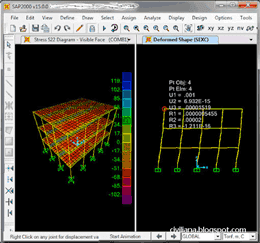
Screenshoot :
CSI SAP2000 Ultimate v 15 version
CSI SAP2000 v 15 Screenshoot
SAP2000 V15 System Requirements
Processor :
  • Minimum: Intel Pentium 4 or AMD Athlon 64;
  • Recommended: Intel Core 2 Duo, AMD Athlon 64 X2, or better;
  • A CPU that has SSE2 support is required;
  • The SAPFire® Analytical Engine includes a multi-threaded solver that can take advantage of multi-core CPUs;
Operating System :
  • Microsoft® Windows XP with Service Pack 2 or later, Microsoft® Windows Vista, or Microsoft® Windows 7, 32- and 64-bit versions;
  • With a 64 bit operating system, the SAPFire® Analytical Engine can utilize more than 4 GB of RAM, making it possible to more efficiently solve larger problems;
Memory :
  • Minimum: 2 GB for XP O/S, 4 GB for Vista/Windows 7 O/S;
  • Recommended: 4 GB for 32-bit O/S, 8 GB or more for 64-bit O/S;
  • The problem size that can be solved & the solution speed increases considerably with more RAM;
  • Vista/Windows 7 requires more RAM than XP for the operating system itself;
Disk Space :
  • 6 GB to install the program;
  • Recommended: 500GB or larger Hard Disk Drive (7200 rpm SATA);
  • Additional space required for running and storing model files and analysis results, dependent upon the size of the models;
Video Card :
  • Minimum: Supporting 1024 by 768 resolution and 16 bits colors for standard (GDI+) graphics mode;
  • Recommended: Discrete video card with NVIDIA GPU or equivalent and dedicated graphics RAM (512 Mb or larger) for DirectX graphics mode. The card must be         DirectX 9.0c compatible (DirectX SDK Aug 2009 - Build 9.27.1734.0);
  • DirectX graphics mode fully utilizes the hardware acceleration provided by a GPU and dedicated graphics RAM;
  • For better graphics quality in terms of anti-aliasing and line thickness, the device raster drawing capabilities should support legacy depth bias;


Ads-Banner Footer